

When was the last time you paused to consider how you got here?
Most of us move through our days without pausing to notice what — or who — is around us. The pace of modern life draws our attention inward, towards our responsibilities, our ambitions and our worries.
Over time, often without realising it, we begin to believe that we arrived here entirely on our own. But that is rarely the full story.
If we take a moment to look back, many of us will see how much our journey has been enabled by others. The boss who took a chance on us. The client who showed patience. The friend who opened a door. The colleague who supported us through a difficult season. Family who stood behind us. The stranger who returned something we had lost. None of us got here alone. Our world is more interconnected than it seems.

Looking Beyond Ourselves
Now, do you believe that goodness, once set in motion, could ripple outward to our communities and society?
In many ways, this idea feels out of place in a world that keeps score. Help is often transactional, even when it comes from a good place. There is an unspoken expectation that giving should be measured, reciprocated, or recognised.
But years ago, I watched a movie that stayed with me.
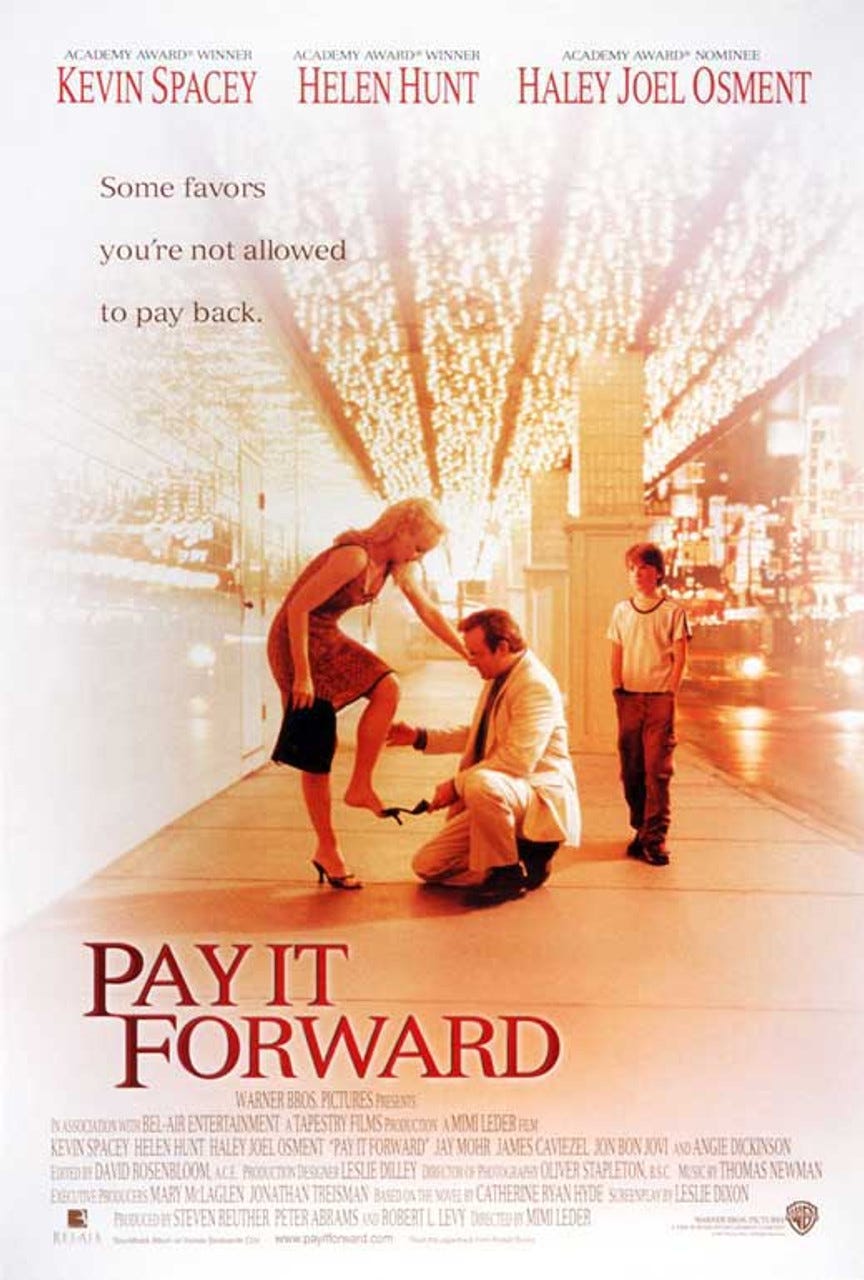
Pay It Forward follows Trevor McKinney, an idealistic eleven-year-old living in Las Vegas with his struggling, recovering-alcoholic mother. His life shifts when his new social studies teacher assigns the class to think of an idea to change the world and put it into action. Trevor responds with a simple but radical plan: do a life-changing good deed for three people, then ask each of them to “pay it forward” by helping three others.
Trevor puts his idea into practice by helping a homeless addict, trying to bring his lonely teacher and mother together, and standing up for a bullied classmate, while navigating family trauma, including the return of his abusive father. Unbeknownst to him, his actions begin to set off a chain of generosity far beyond his immediate world.
Kindness is Contagious
What stayed with me was not the scale of the acts, but their intention. The idea that goodness does not need an endpoint to matter. That goodness can move from one person to another, long after the original act has passed.
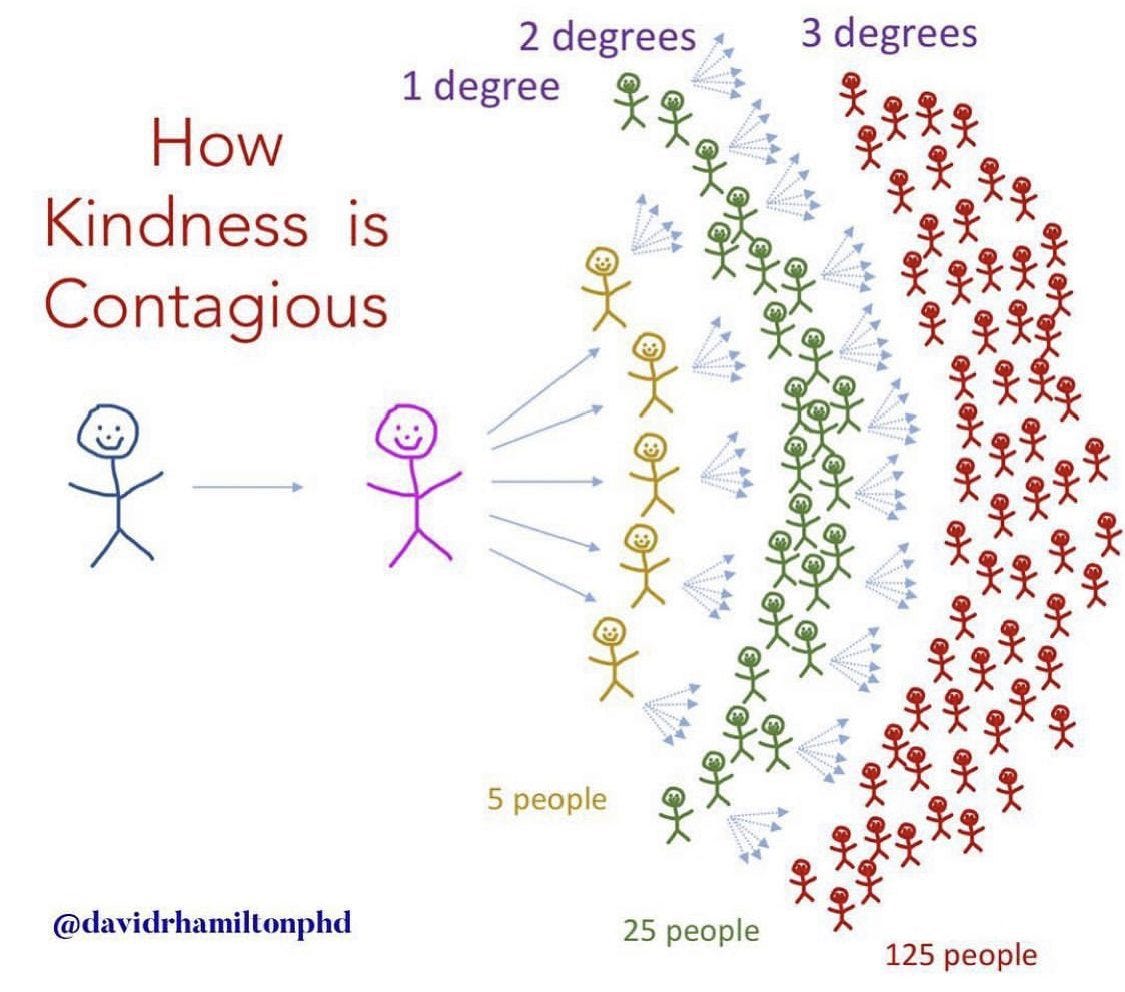
Social science studies show that acts of kindness and generosity can cascade through social networks up to three degrees of separation — reaching friends of friends of friends. Researchers James Fowler and Nicholas Christakis found that behaviours such as happiness, cooperation, and generosity are socially contagious.
When modelled conservatively, this suggests that a single act of kindness can positively influence around 15 to 20 people, including recipients and even those who simply witness the act. Some research also indicates that the effects of positive behaviour can last for months, and in some cases up to a year.
The film Pay It Forward captures this beautifully, reminding us that small, selfless gestures can extend outward in ways we can never imagine.
Sharing Is Where Giving Begins
We tend to underestimate the value of what comes easily to us, forgetting that what feels ordinary in our own hands may be exactly what someone else needs. Sometimes what feels small to you can be life-changing to someone else.
Paying it forward rarely starts with big causes or distant communities. Most of the time, it begins close to home, with the people already around us. It can show up in simple ways, such as holding a door open, letting a person in front of a queue, saying a few words of encouragement or reaching out to someone in need.
Research supports this. People who volunteer regularly tend to have better health outcomes, including lower blood pressure and longer lifespans — a reminder that giving isn’t just moral; it’s physiological.
When we focus on improving the quality of life of those around us through compassion, care, and presence, the impact can be far-reaching.
In many ways, The C-Athlete is how Simone, Novi, and I try to pay it forward. It grew out of our own experiences — the moments of growth, pressure, missteps, and learning that leadership and life inevitably bring. We share not because we have it all figured out, but because we know how valuable it can be to hear from someone who’s been there before. If something we’ve learned along the way helps someone else navigate their journey with a little more clarity or steadiness, then it continues the very ripple this piece speaks to.

A Different Measure of Success
Studies find that social support and generosity — far more than income — are powerful predictors of long-term well-being and fulfilment.
As C-Athletes, many of us are used to measuring progress by what we gain materially or accomplish. Perhaps 2026 offers an opportunity to do so differently.
Not just what we achieve, but what we enable for others. Not just how far we go, but who we help along the way. Some of our contributions might never get recognised, and that is perfectly okay.
This year, here’s my invitation to you: consider doing a life-changing good deed for three people, then ask each of them to “pay it forward” by helping three others in their own way.
What we choose to pass on may travel further than we ever know.
References
The 3-Degree Ripple Rule, Dr. David R Hamilton
Social Networks & Happiness, Nicholas A. Christakis, James Fowler
The World Happiness Report 2025 - Chapter 2: Caring & Sharing